Romold
Romold GRP and containment.

Double IBC / 8 Drum Covered Spill Pallet Bund
£1,975.43EX VAT · £2,370.52 INCView product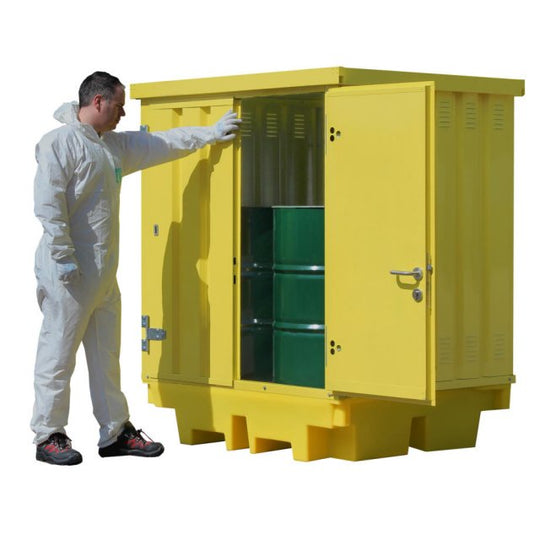
4 Drum Plastic Covered Spill Bund
£2,165.43EX VAT · £2,598.52 INCView product
IBC Plastic Covered Spill Bund
£2,502.57EX VAT · £3,003.08 INCView product
8 Drum / 2 IBC Hard Covered Spill Bund
£3,517.05EX VAT · £4,220.46 INCView product


Talk to a
specialist
Sizing, regulations, installation. Our team has been answering these questions for over 25 years.
Romold FAQs
What makes Romold's Rhino tanks different from steel bunded oil tanks?
Rhino tanks are moulded in one piece from polyethylene, so there are no welded seams to corrode or fail over time — a common weak point on steel tanks. The integral bund (a tank within a tank) holds 110% of the primary tank's capacity as standard, meeting OFTEC and Environment Agency requirements without extra bunding work on site. They're also lighter to handle and won't rust, which matters for coastal or exposed installations.
How do I size a bunded oil tank for a domestic heating system?
Work out your annual oil consumption and aim for a tank that covers roughly one to two deliveries, so you're not paying for part-loads or running dangerously low in winter. Most UK homes are well served by a tank in the 1,200–2,500 litre range, but check available space and access for the delivery tanker's hose reach. If in doubt, size up slightly — a larger tank costs little extra to run and gives you buying flexibility when oil prices move.
Do Romold cable ducting systems need to be colour coded?
Yes — industry convention (and most utility company specifications) requires different colours for different services, such as black for power, yellow or orange for telecoms, and green for street lighting or CCTV. Romold ducting is available pre-coloured to match these conventions, which speeds up NRSWA-compliant installations and avoids confusion during future excavation work. Always confirm the exact colour requirement with the relevant statutory undertaker before ordering.
What are Romold GRP kiosks and cabinets typically used for?
These enclosures house electrical switchgear, telecoms equipment, meters and control panels where a weatherproof, non-conductive housing is needed outdoors. GRP (glass-reinforced plastic) is the material of choice because it doesn't corrode, needs no earthing in the way metal cabinets do, and holds up well to UV exposure and vandalism. They're widely used by DNOs, telecoms providers and on commercial sites for anything from substations to fibre cabinets.
What ground preparation is needed before installing a Romold GRP manhole or inspection chamber?
A firm, level base is essential — typically a compacted granular sub-base or concrete pad sized to the chamber's footprint, checked against the manufacturer's installation guide. Backfill should be in even layers around the chamber to avoid point-loading the GRP walls, and the surround needs to suit the expected load, whether that's pedestrian, driveway or full traffic loading with an appropriate cover. Always confirm invert levels and pipe connections before backfilling, as GRP chambers are far harder to adjust once set.
What lead times should I expect for larger Romold tanks and kiosks?
Standard bunded oil tanks and smaller GRP items are often held in stock and can go out quickly, but larger kiosks, bespoke chambers or bigger capacity tanks are usually made to order and can take several weeks. It's worth confirming exact availability and delivery access requirements before committing to a site programme, particularly for tanker deliveries needing a hard, level offload point. We'll always advise realistic timescales at the point of order rather than leaving you guessing.