HiblowBlowers
Trusted linear air blowers.


Talk to a
specialist
Sizing, regulations, installation. Our team has been answering these questions for over 25 years.
Hiblow Blowers FAQs
What does a Hiblow blower actually do on a sewage treatment plant?
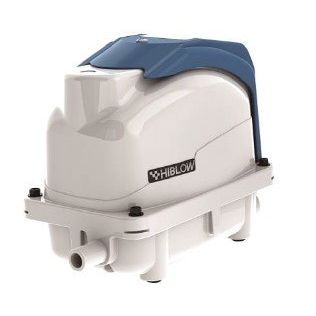
A Hiblow blower is the air pump that drives the aeration process in a sewage treatment plant, pushing oxygen into the treatment chamber to keep the bacteria that break down waste alive and working. Without a functioning blower, biological treatment stops and the plant will start to smell and underperform. It runs continuously (or on a timed cycle depending on the model), so it's effectively the heart of the system.
How do I know which Hiblow model is right for my treatment plant?
Hiblow blowers are sized by airflow output, and most sewage treatment plant manufacturers specify an exact model — commonly the HP-80, HP-100 or HP-120 — for each plant size and population loading. Check your existing blower's model number or your plant's handbook before ordering, as fitting an undersized or oversized unit can affect treatment performance. If you're unsure, we're happy to help match the blower to your plant make and model.
Can I fit a Hiblow blower myself, or does it need an installer?
Swapping a like-for-like Hiblow blower is generally straightforward for a competent homeowner — it's a case of disconnecting the air hose and power lead from the old unit and connecting the new one in the same way. However, the blower must be sited on a stable, level, weatherproof base with adequate ventilation, and mains electrical connections should always be carried out by a qualified electrician. If you're changing the blower type or output as part of a wider repair, it's worth checking with your plant supplier or a service engineer first.
Where should the blower be installed, and does it need a cover?
Hiblow blowers are designed to sit outside, close to the treatment plant, ideally on a small concrete or paved plinth above ground level to avoid flooding and vibration transfer. They should be protected from direct rain and standing water but not fully enclosed in an airtight box, as they need a free flow of air for cooling and intake. A vented cover or purpose-made blower housing is the usual solution, particularly in exposed or coastal locations.
How long do Hiblow blowers last, and do they need servicing?
Hiblow blowers are built for continuous duty and typically run for several years, but the internal diaphragms are a wearing part and should be replaced roughly every two to three years as part of routine maintenance — this is often cheaper than a full replacement blower. Regular servicing, usually every six to twelve months in line with your plant's maintenance schedule, helps catch wear before it causes a failure. A blower running noticeably louder or hotter than usual is often the first sign a diaphragm kit is needed.
Will a Hiblow blower fit a treatment plant made by a different manufacturer?
In many cases, yes — Hiblow blowers are widely used as an OEM component across numerous sewage treatment plant brands, so a genuine Hiblow replacement will often fit even if your plant carries a different manufacturer's name. What matters is matching the airflow output and connection size to your original unit rather than the brand on the casing. If you're not certain, checking the model number on the blower's data plate is the most reliable way to confirm compatibility.