ChemicalStorage
Store aggressive liquids safely.

Chemical Storage Sub-Categories

JFC Medi-Safe Storage Cabinet
£171.20EX VAT · £205.44 INCView product
JFC Wall Mountable 180L Chemical Storage Cabinet
£264.00EX VAT · £316.80 INCView product
JFC Medisafe 180L Wall Mountable Storage Cabinet
£269.00EX VAT · £322.80 INCView product
JFC 380L Chemical Storage Cabinet
£441.00EX VAT · £529.20 INCView product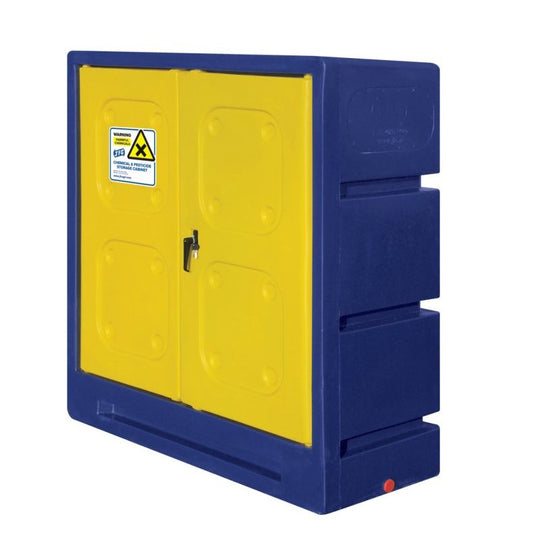
JFC 700L Chemical Storage Cabinet
£716.00EX VAT · £859.20 INCView product
30m3 Camplas GRP Chemical Bulk Storage Tanks
£9,645.00EX VAT · £11,574.00 INCView product
40m3 Camplas GRP Chemical Bulk Storage Tanks
£12,355.00EX VAT · £14,826.00 INCView product
50m3 Camplas GRP Chemical Bulk Storage Tanks
£13,545.00EX VAT · £16,254.00 INCView product


Talk to a
specialist
Sizing, regulations, installation. Our team has been answering these questions for over 25 years.
Safe chemical storage requires the right equipment and proper planning. That's why we stock everything from compact dosing tanks for precise applications right through to IBCs and bulk storage tanks for larger operations. Our range extends beyond storage too €“ we've got the washdown equipment you need for proper maintenance, spill kits for those just-in-case moments, and chemical pumps to handle transfer safely. We know that chemical storage isn't one-size-fits-all, which is why we offer bespoke quotations for larger tanks €“ just complete our online form with your Safety Data Sheet, and we'll work out exactly what you need. If you're after something specific like mixing tanks or have particular requirements, give us a call.
Chemical Storage FAQs
What material should my chemical storage tank be made from?
It depends entirely on the chemical you're storing — acids, alkalis and oxidising agents all react differently with plastics. Polyethylene (MDPE/HDPE) tanks suit a wide range of common chemicals and are the most cost-effective option, while GRP and specialist-lined tanks are used for more aggressive substances. Always check your Safety Data Sheet against the tank manufacturer's chemical resistance chart before ordering.
Do I need a bunded tank for chemical storage?
In most cases, yes. Environment Agency guidance requires secondary containment (bunding) capable of holding at least 110% of the tank's capacity, or 25% of total stored volume across multiple tanks, whichever is greater. This applies whether you're storing a single bulk tank or several IBCs, and integrally bunded tanks are usually the simplest way to meet this without building a separate bund wall.
What's the difference between a dosing tank and a bulk storage tank?
Dosing tanks are smaller, precision vessels designed for metering controlled amounts of chemical into a process — think water treatment or effluent dosing — and are usually fitted or fittable with dosing pumps. Bulk storage tanks and IBCs, by contrast, are sized for holding larger reserves ready for transfer or gradual use. Which you need depends on whether the chemical is being fed continuously into a system or simply stockpiled for later use.
How do I work out what size chemical tank I need?
Start with your expected usage or delivery frequency — smaller dosing tanks suit low, controlled consumption, while IBCs and bulk tanks make sense if you're taking large deliveries to reduce reordering. Also factor in available space, since bunding requirements will add to the tank's overall footprint. If you're unsure, send us your Safety Data Sheet and usage figures and we'll help you size it correctly.
Can you supply chemical tanks larger than what's listed online?
Yes — for larger or bespoke chemical storage requirements we work up a tailored quotation rather than listing every configuration online. Complete our enquiry form with your Safety Data Sheet and required capacity, and we'll specify the correct tank material, bunding and fittings for your application. This is also the best route if you need a mixing tank or another non-standard vessel.
What else do I need alongside a chemical storage tank?
Beyond the tank itself, most installations need a compatible transfer pump rated for the chemical in question, along with suitable hose, fittings and a lockable cabinet or compound if required by your COSHH assessment. A spill kit matched to the chemical type should be kept on site as standard practice, and washdown equipment makes routine maintenance and decontamination straightforward. We stock all of these alongside our tank range.