
Twin
Twin-pump configurations.

Vari-Rs Featuring Grundfos Twin booster Pump With TD Variable Speed Controller 73L/MIN @ 4.5 BAR
£3,425.00EX VAT · £4,110.00 INCView product
Vari-Rs Featuring Grundfos Twin booster Pump With TD Variable Speed Controller, 108L/MIN @ 4.5 BAR
£3,534.00EX VAT · £4,240.80 INCView product
VARiFLO Featuring Lowara Twin Booster Pump with Variable Speed controllers | 170 l/min @ 5.1 Bar
£3,634.00EX VAT · £4,360.80 INCView product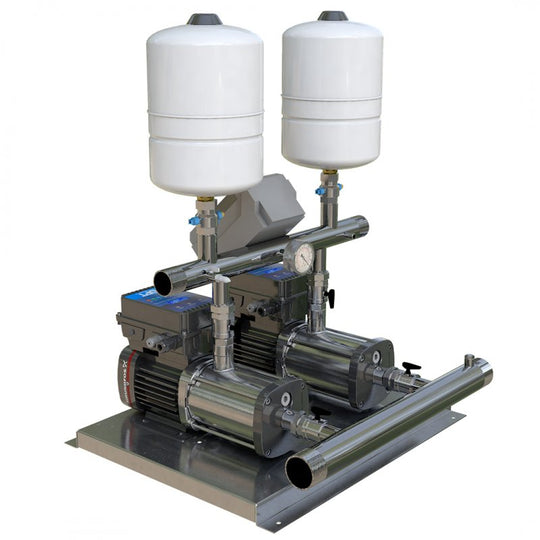
Vari-Rs Featuring Grundfos Twin booster Pump With TD Variable Speed Controller, 73L/MIN @ 6.5 BAR
£3,641.00EX VAT · £4,369.20 INCView productVari-Rs Featuring Grundfos Twin booster Pump With TD Variable Speed Controller, 108L/MIN @ 6.5 BAR
£3,717.00EX VAT · £4,460.40 INCView product
Vari-Rs Featuring Grundfos Twin booster Pump With TD Variable Speed Controller, 250L/MIN @ 4.5 BAR
£4,187.00EX VAT · £5,024.40 INCView product


Talk to a
specialist
Sizing, regulations, installation. Our team has been answering these questions for over 25 years.
Twin FAQs
What does "twin" or "bunded" actually mean on these tanks?
A twin tank is a tank-within-a-tank: an inner storage vessel sits inside an outer skin, with the gap between the two acting as secondary containment (the bund). If the inner tank fails or leaks, the contents are captured by the outer skin rather than escaping to ground or drains, which is why they're specified for oils, chemicals and other environmentally hazardous liquids.
Do I actually need a bunded twin tank, or will a single-skin tank do?
If you're storing diesel, heating oil, or any substance that could pollute land or watercourses, the Control of Pollution (Oil Storage) Regulations and Environment Agency guidance generally require secondary containment — a twin (bunded) tank satisfies this in one unit rather than needing a separate bund wall. For clean water storage with no environmental risk, a single-skin tank is usually adequate and more cost-effective.
What bund capacity do twin tanks provide, and does it meet regulations?
Our twin tanks are manufactured with a bund capacity of at least 110% of the inner tank's volume, which is the standard regulatory requirement in the UK for oil and chemical storage. This means the outer skin can hold the full contents of the inner tank plus a margin, even in the event of complete failure.
Can twin tanks be used to store potable water?
Some twin-wall tanks are manufactured and WRAS-approved for wholesome water storage, but not all — many in this range are designed specifically for fuels, oils or non-potable liquids. Always check the individual product spec for WRAS approval before using a twin tank for drinking water, and contact us if you're unsure which model suits your application.
What are twin tanks typically made from?
Most twin tanks in this range are moulded from medium-density polyethylene (MDPE) or high-density polyethylene (HDPE), chosen for its resistance to corrosion, UV stability and impact strength. This makes them suitable for permanent outdoor installation without the rusting or degradation issues associated with older steel bunded tanks.
Can twin tanks be installed below ground, or are they above-ground only?
The vast majority of twin/bunded tanks in this collection are designed for above-ground installation on a firm, level base, typically outdoors against a wall or on standalone legs. If you need underground storage with equivalent secondary containment, you'll want a purpose-built underground bunded tank rather than a standard twin tank — check with us before ordering if you're unsure.